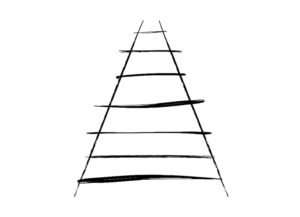
This is a ladder.
I want you to imagine that, as you climb this ladder, you’re
gradually learning more about something. The higher up you
get, the more you know.
You’re probably looking at it thinking that you’re way down at
the bottom, gazing upwards at the tiny, distant rungs at the
top. Looking at it that way, the image is a little bit
intimidating.
Every regular ladder appears like that when you’re looking up
at them from the base.
I think about this shape of ladder a lot when I’m thinking
about anarchism, and talking to people about politics more
generally.
You see, if you know a lot about a thing then you start using
the lingo: you collect a shared dictionary with others who
know about it too. You get to use shiny words and concepts
that help you to chat together as a kind of shorthand for
complicated ideas or arguments.
That doesn’t make you a terrible person. We all do it, whether
we’re talking about baking cakes or techno or plumbing or
whatever. It helps us save time and create a shared sense of
belonging.
The problem is when we start talking to people who don’t have
the lingo, and we either forget that they don’t know what
we’re on about, or else we remember but we don’t want to
patronise them, so we use it hoping they’ll get used to it.
When we do that, it’s pretty likely that those people feel
like they’re looking up at a ladder from the ground. They know
it’s technically possible to climb it, but that those far
away, perilous top rungs are miles off where they are right
now. The ladder looms over them.
I’m sure that when you’ve been learning something difficult,
you’ve no doubt had the same feeling of vertigo. That ladder
of knowledge, teetering above you, could crush you at any
moment.
But what if this is in fact a flat shape, and you’re actually
looking at this ladder straight-on? That would mean the lower
rungs are wider, much wider, than those at the top, which are
extremely narrow.
How do you feel now? Those first steps look pretty chunky now,
yeah? If you’re still thinking like a learner, then I’m
guessing you might now think it wasn’t you being timid, it
wasn’t your fault that those teeny upper levels gave you the
fear because they really do demand you to be more nimble and
confident to climb them. But by the same token, the parts
nearer ground level seem much more sturdy now.
So I think about this ladder a lot, and when I say that, I
mean that when we’re trying to bring people into our politics,
into our chats and movements and rabble-rousing, we need to
make sure that it’s easy to get on the ladder, that those
lower rungs are broad and welcoming and unintimidating.
And that’s Ladder Principle #1: The first rung is wider
Look, we don’t need to communicate solely in memes and one-
syllable slogans. People aren’t stupid. And there’s a time and
a place for complicated, technical chats or difficult words. I
love them! The view from the top of the ladder is amazing.
But in the grand scheme of things, I need to remember that
there’s hardly room for anyone on those little steps; the
audience for that sort of stuff is tiny, and I need to
radically minimise the amount of effort I put into that,
compared to things that genuinely build and grow our movements
into something with broad appeal.
So we get Ladder Principle #2:
For me, the size of the first step on this ladder also means
that we should devote more of our resources (whether that’s
time, energy, printer ink, or whatever) into getting people
onto the thing in the first place.
I suppose the final way I find this metaphor handy is that we
should consciously think about giving folk a comradely hand as
we all head upwards. I think this ladder idea is really useful
for that.
Which gives us Ladder Principle #3: Climb down to help people
climb up
When I’m writing, or talking, or doing some kind of activism,
I need to keep pinching myself to ask “where am I on the
ladder right now? Am I talking down from a lofty rung? Am I
pitching this in the most accessible way possible?”
It’s an old, old cliché that every journey begins with the
first step, but I don’t know if you’ve ever tried climbing a
ladder by jumping onto the second or third rung? It’s pretty
hard and you’ll probably fall straight off.
Nobody gets on the ladder except via the bottom step. So make
it wide, make it welcoming and make it most of your work.
We need a lot of people on this climb.
We ascend together.
Tips and ideas about better communication
– Never, ever use a long or technical word when a shorter
or non-technical one will do. (I basically stole this one
from George Orwell)
– Real-world examples and everyday struggles often explain
things better than abstract concepts. Visuals (diagrams,
colours, pictures of ladders) are great too.
-Clear and heartfelt communication that reaches a lot of
people is, in my view, simply a better use of your time
than complicated stuff that only a few can understand.
– If you can’t be easily understood, that’s a you problem.
– Not being understood is horrible and frustrating, but the
only way to get better at it is practice, practice,
practice!
– When people don’t understand you, their feelings of
inadequacy are much harder (and more important) than your
feelings of frustration
– Monologues are bad (except this one LOL). Mutually ask
questions and share experiences, always. Otherwise you’re
nattering down the ladder.