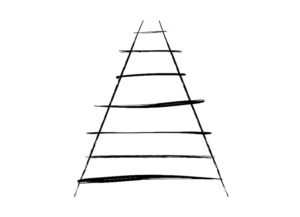
This is a ladder.
I want you to imagine that, as you climb this ladder, you’re gradually learning more about something. The higher up you get, the more you know.
You’re probably looking at it thinking that you’re way down at the bottom, gazing upwards at the tiny, distant rungs at the top. Looking at it that way, the image is a little bit intimidating.
Every regular ladder appears like that when you’re looking up at them from the base.
I think about this shape of ladder a lot when I’m thinking about anarchism, and talking to people about politics more generally.
You see, if you know a lot about a thing then you start using the lingo: you collect a shared dictionary with others who know about it too. You get to use shiny words and concepts that help you to chat together as a kind of shorthand for complicated ideas or arguments.
That doesn’t make you a terrible person. We all do it, whether we’re talking about baking cakes or techno or plumbing or whatever. It helps us save time and create a shared sense of belonging.
The problem is when we start talking to people who don’t have the lingo, and we either forget that they don’t know what we’re on about, or else we remember but we don’t want to patronise them, so we use it hoping they’ll get used to it.
When we do that, it’s pretty likely that those people feel like they’re looking up at a ladder from the ground. They know it’s technically possible to climb it, but that those far away, perilous top rungs are miles off where they are right now. The ladder looms over them.
I’m sure that when you’ve been learning something difficult, you’ve no doubt had the same feeling of vertigo. That ladder of knowledge, teetering above you, could crush you at any moment.
But what if this is in fact a flat shape, and you’re actually looking at this ladder straight-on? That would mean the lower rungs are wider, much wider, than those at the top, which are extremely narrow.
How do you feel now? Those first steps look pretty chunky now, yeah? If you’re still thinking like a learner, then I’m guessing you might now think it wasn’t you being timid, it wasn’t your fault that those teeny upper levels gave you the fear because they really do demand you to be more nimble and confident to climb them. But by the same token, the parts nearer ground level seem much more sturdy now.
So I think about this ladder a lot, and when I say that, I mean that when we’re trying to bring people into our politics, into our chats and movements and rabble-rousing, we need to make sure that it’s easy to get on the ladder, that those lower rungs are broad and welcoming and unintimidating.
And that’s Ladder Principle #1: The first rung is wider
Look, we don’t need to communicate solely in memes and one- syllable slogans. People aren’t stupid. And there’s a time and a place for complicated, technical chats or difficult words. I love them! The view from the top of the ladder is amazing.
But in the grand scheme of things, I need to remember that there’s hardly room for anyone on those little steps; the audience for that sort of stuff is tiny, and I need to radically minimise the amount of effort I put into that, compared to things that genuinely build and grow our movements into something with broad appeal.
So we get Ladder Principle #2:
For me, the size of the first step on this ladder also means that we should devote more of our resources (whether that’s time, energy, printer ink, or whatever) into getting people onto the thing in the first place.
I suppose the final way I find this metaphor handy is that we should consciously think about giving folk a comradely hand as we all head upwards. I think this ladder idea is really useful for that.
Which gives us Ladder Principle #3: Climb down to help people climb up
When I’m writing, or talking, or doing some kind of activism, I need to keep pinching myself to ask “where am I on the ladder right now? Am I talking down from a lofty rung? Am I pitching this in the most accessible way possible?”
It’s an old, old cliché that every journey begins with the first step, but I don’t know if you’ve ever tried climbing a ladder by jumping onto the second or third rung? It’s pretty hard and you’ll probably fall straight off.
Nobody gets on the ladder except via the bottom step. So make it wide, make it welcoming and make it most of your work.
We need a lot of people on this climb.
We ascend together.
Tips and ideas about better communication
– Never, ever use a long or technical word when a shorter or non-technical one will do. (I basically stole this one from George Orwell)
– Real-world examples and everyday struggles often explain things better than abstract concepts. Visuals (diagrams, colours, pictures of ladders) are great too.
-Clear and heartfelt communication that reaches a lot of people is, in my view, simply a better use of your time than complicated stuff that only a few can understand.
– If you can’t be easily understood, that’s a you problem.
– Not being understood is horrible and frustrating, but the only way to get better at it is practice, practice, practice!
– When people don’t understand you, their feelings of inadequacy are much harder (and more important) than your feelings of frustration
– Monologues are bad (except this one LOL). Mutually ask questions and share experiences, always. Otherwise you’re nattering down the ladder.